Crunch, Ooze, Snap, Squish: Why What Your Dessert Feels Like Matters More Than Ever
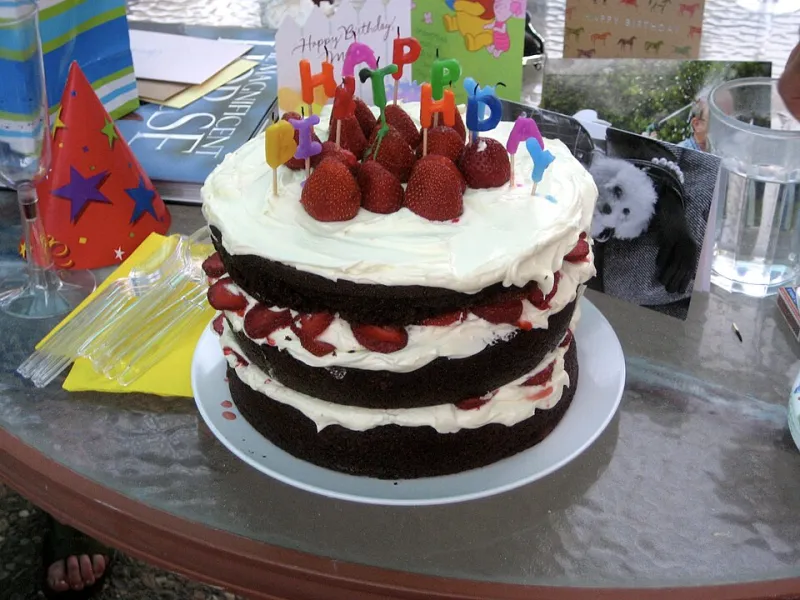
Photo: Vernice Karbe, CC BY-SA 4.0, via Wikimedia Commons
Close your eyes and think about the best dessert you've ever eaten. Got it? Now here's a question: when you replay that memory, are you thinking about the flavor first — or the feeling? The way it shattered between your teeth, or melted slowly across your tongue, or had that one perfect moment where the crispy shell gave way to something impossibly soft underneath?
If it's the latter, congratulations. You are a texture person. And in 2024, the entire gourmet dessert world is extremely on your side.
Across the US, pastry chefs, dessert entrepreneurs, and food scientists are waging a quiet revolution — not in flavor profiles, but in mouthfeel. The new frontier of high-end sweets isn't a more complex taste. It's a more complex physical experience. Welcome to the age of textural contrast, where what your dessert does in your mouth is just as important as what it tastes like. Possibly more.
A Brief, Slightly Nerdy History of Texture in Desserts
Humans have always had feelings about food texture — we just didn't have the vocabulary to talk about it. Ancient Roman confectioners were already playing with the contrast between crunchy honeyed nuts and soft cheeses. Medieval European pastry makers figured out pretty quickly that a flaky crust made the filling underneath taste better by comparison. And when the French started getting serious about patisserie in the 17th and 18th centuries, textural contrast became a full-on design principle. The mille-feuille — those gorgeous layered pastries with shattery puff pastry and silky cream — is basically a masterclass in playing textures against each other.
Fast forward to the 20th century, and American dessert culture went in a slightly different direction: smooth, creamy, and uniform became the gold standard. Think Jell-O, pudding, soft-serve, the classic American layer cake with its fluffy frosting. Consistency was king. Texture was something that happened by accident, not by design.
But something shifted. Food culture got more adventurous. The internet let people discover Japanese mochi, Korean bingsu, Middle Eastern knafeh, and French entremets — desserts from cultures that had been doing wild textural things for centuries. And suddenly, American dessert lovers woke up and realized they'd been living in a one-texture world, and they wanted more.
The Science of Why Textural Contrast Feels So Good
Okay, here's where it gets genuinely fascinating. Food scientists have a term for the pleasure of textural contrast: dynamic sensory perception. The idea is that when different textures hit your mouth in sequence — or simultaneously — your brain has to work a little harder to process the experience, and that cognitive engagement actually amplifies the pleasure response.
In simpler terms: your brain loves a surprise. When you bite into something that looks uniform but turns out to have a molten center, or a crunchy shell hiding a cloud-soft interior, there's a little neurological party happening. It's the same reason a perfectly tempered chocolate bar snaps satisfyingly — that crack isn't just auditory. It signals quality, freshness, and craftsmanship to your brain before the flavor even registers.
Pastry chefs have known this intuitively for years. Now food scientists are catching up with the data to prove it.
What the Chefs Are Actually Doing
Walk into any serious pastry kitchen in New York, Chicago, Los Angeles, or — increasingly — smaller cities like Denver and Raleigh, and you'll find chefs obsessing over textural engineering in ways that would make a materials scientist nod approvingly.
The crispy-on-the-outside, gooey-on-the-inside brownie has become something of a white whale for pastry chefs — everyone's chasing the perfect version, where the top crackles like a crème brûlée crust and the inside is essentially a warm chocolate cloud. Getting there requires precise temperature control, specific fat ratios, and the kind of attention to detail that borders on the religious.
Mousse cakes are another major battleground. The classic French entremet — those mirror-glaze beauties you've definitely seen all over Instagram — layers mousse, cake, crunch elements, and gelée in a single slice designed to hit multiple textures in every bite. Chefs add feuilletine (crushed waffle-like wafers) for crunch, use mirror glaze for a surface that's silky-smooth against your lips, and engineer the mousse layers to be light enough to dissolve while the cake base provides resistance.
And then there's the savory-sweet crunch moment — the sprinkle of fleur de sel on a caramel, the shards of praline on top of a panna cotta, the sesame tuile balanced on a scoop of miso ice cream. These aren't garnishes. They're structural decisions.
The Mouthfeel Revolution Goes Mainstream
What's exciting — and very on-brand for the Squishy Cream extended universe — is that this obsession with texture isn't staying in fancy restaurants. It's trickling down to home kitchens and mainstream dessert shops in a big way.
Trending recipes on food sites and social platforms consistently feature textural drama as the hook. Viral brownie recipes promise that specific crinkle-top crunch. Whipped coffee and cloud cake videos rack up millions of views because people are transfixed by the visual texture before they've even tasted anything. The "crunchy top, soft bottom" cheesecake has become a home baker obsession. And don't even get started on the "burnt Basque cheesecake" trend — a dessert that is deliberately charred on the outside and custardy in the middle, and tastes absolutely unhinged in the best possible way.
For the home cook who wants to play in this space, the good news is that textural contrast doesn't require a culinary degree. A handful of toasted nuts on a mousse cup. A sprinkle of crushed graham cracker on a panna cotta. Letting your brownies cool completely before cutting so the edges stay crisp. These are small moves with outsized sensory payoffs.
The Squish Is the Point
At the end of the day — or the dessert course, as it were — the texture revolution is really just the food world catching up to something that squishy, gooey, crackly dessert lovers have always known in their bones.
Flavor gets you interested. Texture makes you feel something.
That moment when a perfectly made macaron gives that slight resistance before yielding completely? That's not an accident. The way a really good ice cream sandwich lets the cookie compress just slightly before the cold cream hits your tongue? Engineered joy. The crack of a chocolate shell on a frozen dessert bar? Pure theater, and you are the audience.
So the next time someone asks you what your favorite dessert flavor is, maybe think a little bigger. What does it do? How does it move? Does it crunch, snap, melt, squish, or dissolve? Because in the most delicious possible way, texture is the new taste — and it has been waiting a long time for its close-up.